Revealing the Glories of Ancient Hippos
The relatively small area of this little city detracts nothing from the impressive architectural remains one beholds as the casual observer traverses its ancient streets. "Monumental" is the best word that comes to mind when describing this fortified Hellenistic-Roman style space and its commanding view of the surrounding countryside.
Known as the ancient city of Hippos-Sussita, it is located on the east shore of the Sea of Galilee, on top of a flat, diamond shaped mountain, 350 m above the lake. Sussita, or as it was known by its Greek name, Antiochia-Hippos, was founded after 200 BC, when the Seleucids seized the Land of Israel from the Ptolemies. During the Roman Period Hippos belonged to the Decapolis, a group of ten cities which were regarded as centers of Greek culture in an area predominantly populated by Semitic peoples such as Jews, Aramaeans, Ituraeans, and Nabataeans.The cities of the Decapolis had much in common. Most were founded during the Hellenistic period and were given the encouragement and support of the Seleucid kings, who saw them as a counterweight to the kingdoms that lay to the west (the Hasmonaean Kingdom of Judaea) and to the east (the Nabataean kingdom). Most of the population in the cities was Hellenised and the citizens saw themselves as citizens of a polis in every respect.
The Project
The research of Hippos-Sussita is an international Israeli-Polish-American project collaboration co-directed by: Professor Arthur Segal from the Zinman Institute of Archaeology, University of Haifa; Professor Jolanta Mlynarczyk from the Research Centre for Mediterranean Archaeology, Polish Academy of Sciences; Dr. Mariusz Burdajewicz of the National Museum, Warsaw; Professor Mark Schuler from Concordia University, St Paul, USA; and Mr. Michael Eisenberg, a PhD candidate from the Zinman Institute of Archaeology who serves as Professor's Segal assistant. The objective of the expedition is to uncover the entire ancient city, the street network, the main public secular and religious buildings, as well as the domestic quarters. The expedition also hopes to survey and excavate the two necropoleis located to the south and south-east of the city. The relationship between the city and the surrounding countryside will also be examined in future seasons, especially the area stretching between the city and the lake. Further, they plan to conduct a detailed survey of the lake's shore to establish the exact location of Hippos' port.
The 2009 Goals
During the summer of 2009 (July 5 --July 30), the team plans to:- Continue the excavation of the Roman Monumental Arch area, east of the Hellenistic Compound;
- Reveal more of the Roman Monumental Building west of the Forum;
- Complete the documentation and preservation of the North West Church;
- Complete the excavation and preservation of the North East Church;
- Complete the excavation of the insula located between the North East Church and the Decumanus Maximus;
- Continue the excavation of the Roman Byzantine Bath located between the Forum and the southern city wall; and
- Continue the preservation treatment in all the sites exposed so far
The project directors are inviting students and volunteers from all over the world to come join them in this exciting long-term expedition. If you are interested, go to http://hippos.haifa.ac.il for more detailed information and to find out how to apply.
Labels: archaeological digs in israel, hellenistic archaeology, roman archaeology
Tel Dor by the Sea
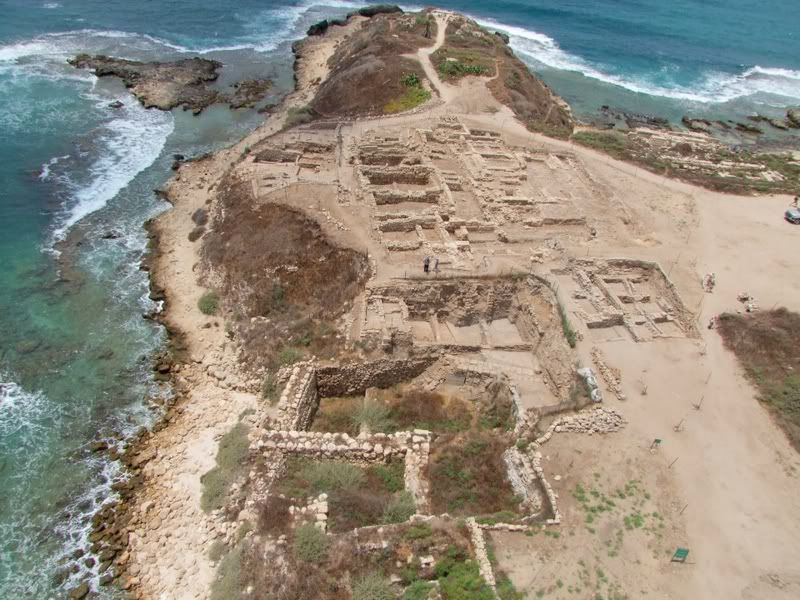
About 30 kilometers directly south of Haifa, Israel, lies a very large tel (an earth mound containing ancient architectural and artifact remains) that tells a story crossing at least eight civilizations. The story is largely a commercial one, as the ancient seaport city of Dor on the Mediterranean coast of present day Israel was host to the trading activities of a number of civilizations or cultures that ringed the Mediterranean world in ancient times. Once a Canaanite city, its history spans settlement or rule by "Sea Peoples", Phoenicians, the Solomonic monarchy, Assyrians, Persians, Greeks, and Romans. Finally, in the thirteenth century A.D., a Crusader castle was built on the site. Few sites of the ancient world can boast a settlement history more varied and complex than this.
The 2009 Excavation Season
From July 6 to August 12, the University of Washington (UW) Tel Dor Archaeological Program will resume its field school excavation at Dor under the direction of Professor Sarah Culpepper Stroup. The majority of the participants will be excavating the Hellenistic and late Persian strata under the leadership and instruction of Professor Stroup and associated staff. The area consists of a fascinating complex of industrial buildings. Discoveries from the 2007 season included four large Roman-period tabuns (round local ovens), each of differing construction, several drains and basins, hallways,thresholds, and massive amounts of Roman-period pottery. In the 2008 season, the team excavated through the Roman strata and uncovered the tops of beautifully constructed Hellenistic period walls. Also uncovered were large amounts of fine Hellenistic mold-made ("Megarian") pottery, a few fine pieces of Hellenistic glass, an assortment of bronze tools and weapons, and a somewhat puzzling ashlar installation that instantly gained the affectionate nickname "the crypt". The 2009 season promises to be an exciting one as the expedition returns to more fully explore the Hellenistic strata. Other participants will have the opportunity to excavate in an area with earlier strata -- under the leadership and instruction of Talia Goldman and Yftah Shalev, Israeli graduate students who are also experienced archaeologists and teachers with a long history at Dor. Due to its situation on the south slope of the Tel, this area is stratigraphically rich, with upper levels in the Persian Period and lower levels approaching the Bronze Age. Past discoveries have included -- in the Persian strata -- three dog burials, a street front, a puzzling triple-layer hemicircle of long bones and amphora handles and -- in the Iron Age strata -- a complex of mud-brick rooms and nearly complete vessels filled with lentils and grain. Always an interesting area, its location also boasts the best views of the bay!
The Field School
One of the hallmarks of the Tel Dor Archaeological Program is its rich and intensive course of study, consisting of three major components:
1. Field Work
Students will learn about the past as they unearth it. All students registered in the Field School receive daily instruction and participate each day in the archaeological excavations at Tel Dor. Field excavation is supervised by an experienced team of international archaeologists from Hebrew University in Jerusalem, the University of Haifa, the University of Washington in Seattle, and other institutions, and includes training in excavation techniques, stratigraphy, artifact analysis, and transit elevations.
2. Museum Work
Students will learn what happens to an artifact after it has been excavated. They will receive instruction in various aspects of museology, including cataloguing systems, pottery typology, dating methods, and conservation techniques.
3. Evening Lectures
Students will learn the concepts behind the archaeology. They will attend four evening lectures per week on such diverse topics as the history of Tel Dor, the histories of the civilizations who occupied it, past excavations, day-plans and day-book methods, the ‘digitization’ of modern archaeology, three-dimensional imaging of artifacts, architectural drafting, and a great deal more.
Those who successfully complete the course requirements of the Field School will receive 12 credits (either graded or C/NC) from the University of Washington in either Classics (CLAS) 399, Near Eastern Languages and Civilizations (NELC) 399, or Archaeology (ARCH) 270. These credits can be counted toward a major in these programs.
Join Us
Don't just read about history. Help make a difference -- feel it, discover it, and make it a part of you. You can learn more about the project and the application procedure by going to the website at http://depts.washington.edu/teldor or, alternatively, at http://dor.huji.ac.il.
Contact Information:
Professor Sarah C. Stroup
scstroup@u.washington.edu
Labels: archaeological excavation at tel dor, archaeology in israel, field school in roman archaeology, hellenistic archaeology, tel dor


